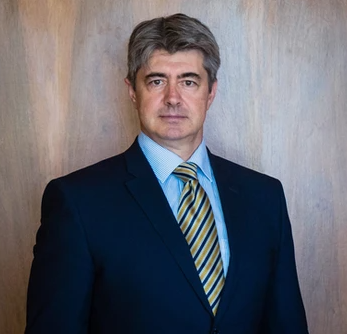
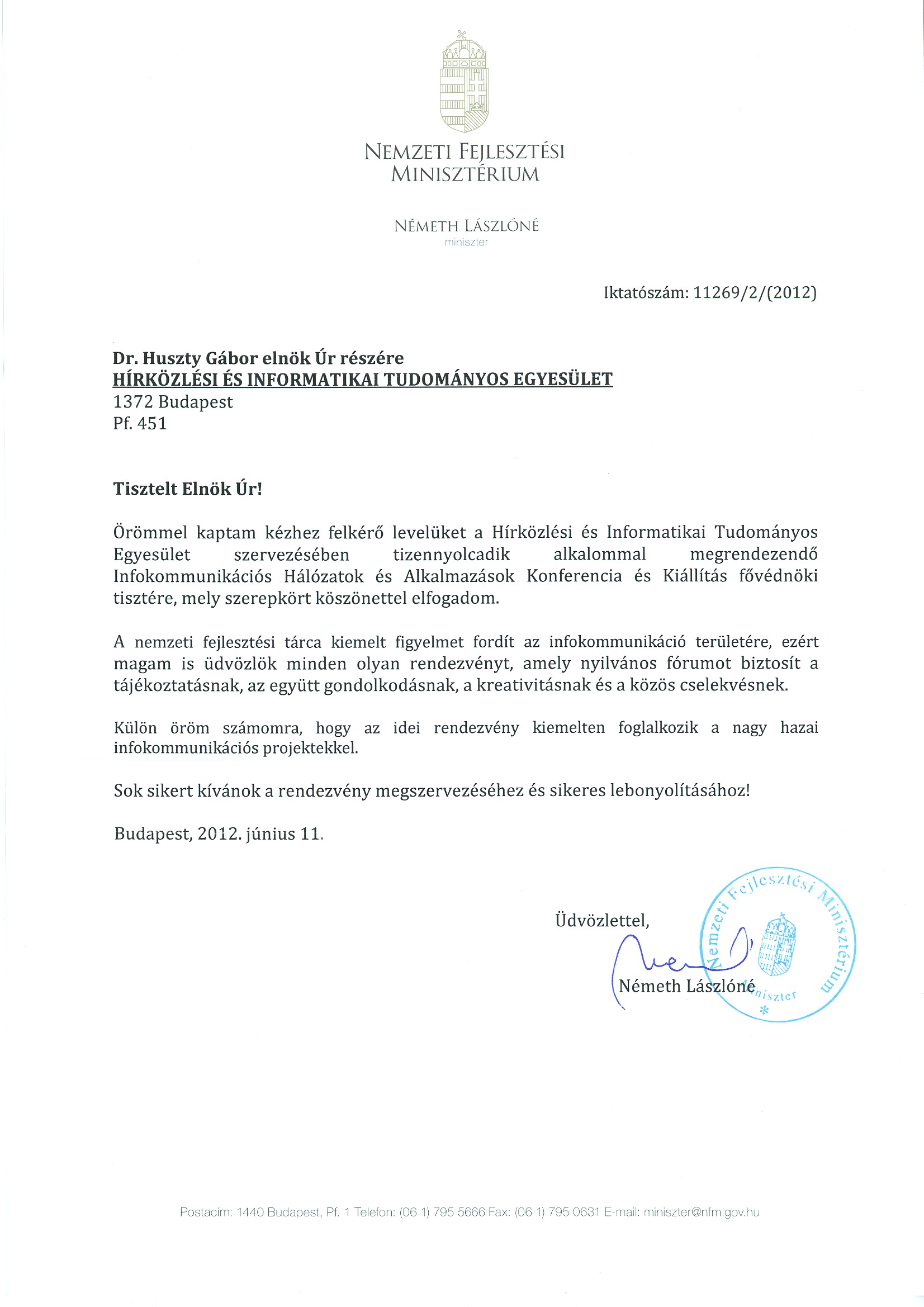
Fővédnöki felkérés elfogadása
Németh Lászlóné, Nemzeti Fejlesztési Miniszter Asszony elfogadta a fővédnöki felkérést.
Area Editors
|
Eszter Udvary Eszter Udvary received her Ph.D. degree in electrical engineering from the Budapest University of Technology and Economics (BME), Budapest, Hungary, in 2009. She is currently an Associate Professor at BME, Mobile Communication and Quantum Technologies Laboratory. Dr. Udvary's research interests are in the broad area of optical communications, including microwave photonics, optical access network, visible light communication, and quantum communication. |
Péter Baranyi Professor Baranyi obtained his Ph.D. in Informatics in 1999 and became the Doctor of Hungarian Academy Sciences in 2006. He is a member of the Hungarian Academy of Engineering. His work has been recognized with several international awards, including the Kimura Award, International Dennis Gabor Award, and the young investigator award by Sigma XI. In the field of non-linear control theory, Professor Baranyi developed the TP model transformation, which is a higher-order singular value decomposition of continuous functions, structures, or dynamic models. This transformation plays a crucial role in non-linear control design theories and opens up new theory for optimization. Around 2010, Professor Baranyi introduced the concept of Cognitive Infocommunications (CogInfoCom). Since then, CogInfoCom has evolved into a scientific discipline, giving rise to various branches including, for instance, Mathability, Digital Reality, Digital & Cognitive Corporate Reality, and Socio-Cognitive ICT. Within the field of CogInfoCom, Professor Baranyi led a research group investigating the cognitive aspects of Virtual Reality for application in corporate environments. His research group was the first to discover that users could achieve 40-50% better effectiveness in 3D digital environments.
| |
|
Lajos Nagy Lajos Nagy received the Engineer option Communication and PhD degrees, both from the Budapest University of Technology and Economics (BME), Budapest, Hungary, in 1986 and 1995, respectively. He joined the Department of Microwave Telecommunications (now Broadband Infocommunications and Electromagnetic Theory) in 1986, where he is currently an associate professor. He has been the head of Department of Broadband Infocommunications and Electromagnetic Theory in 2007. He is a lecturer on graduate and postgraduate courses at BME on Antennas and radiowave propagation, Radio system design, Adaptive antenna systems and Computer programming. His research interests include antenna analysis and computer aided design, electromagnetic theory, radiowave propagation, communication electronics, signal processing and digital antenna array beamforming, topics, where he has produced more than 100 different book chapters and peer-reviewed journal and conference papers. Member of Scientific Association for Infocommunications, official Hungarian Member and Hungarian Committee Secretary of URSI, Chair of the IEEE Chapter AP/ComSoc/ED/MTT.
|
Holczer Tamás
| |
|
|